
Watching films must surely rate as of the most risk-free hobbies possible. But actually running a film society could be hazardous in all sorts of ways. I’ve previously mentioned that we had a relaxed attitude to health and safety – that is, we ignored it entirely, other than to follow some very specific rules handed down from generation to generation. But with the benefit of twenty years’ hindsight, it’s surprising we didn’t end up with all sorts of injuries.
Former projectionists will, no doubt, be able to guess what item appears at #1. Buckle yourselves in for a horror ride that is very much in the spirit of that time we dressed up ourselves as ghouls, and the theatre itself as a haunted, cobwebby dungeon, for a special Halloween showing of noted gore-fest Practical Magic.
8. The audience from hell
Danger of death: 0.2%
We always strove for professionalism. We never deliberately set out to annoy our audiences. But there were times when we fell short of expectations. And, for some of those times, our actions were certain to antagonise our audiences.
Sometimes, films failed to turn up; this was outside of our control. Sometimes, the equipment or the film print itself weren’t up to scratch; this was also outside of our control. Quite often in these circumstances, we’d pin a note to the theatre door and scarper. This felt reasonable at the time. None of us had any customer services training, and nobody really wanted to deal with aggrieved punters – especially members of the public who had paid good money for a University Arts Cinema showing. Most of us were engineering or science students: we could barely look strangers in the eye at the best of times.
We were pretty adept at disappointing people in unpredictable ways. One season, we had a 16mm Cinemascope film in one week, followed by a video-projected film the next; returning audiences were disappointed by the relative lack of image scale and quality. In another season, our main projector had broken down; we elected to use a portable projector, with short intermissions every half an hour or so to change the reel. (It was also a very long film. The projectionist – I think it was Rob – deliberately cranked the projector speed up in order to get home sooner.)
Some people complained that our films were just too quiet, lacking the aural intensity of a real cinema. So we borrowed a phat sound system from AVS, and spent the next day fielding complaints from attendees of the evening lecture next door.
Lesson: Know your limits and embrace your imperfections – or simply run away.
7. The Sisyphean furniture removals
Danger of death: 4%
We didn’t just turn up and press play in those days; film presentations involved an amount of setup and tidying. Our speakers had to be carried to the front of the theatre and set up on tall stands. Sometimes, we even remembered to plug them in as well. Our “box office” had to be set up in the foyer area outside the LT-G rear doors; we also had to carry a boiling kettle up two storeys, to make the tea.
One daily challenge was the awkward layout of neighbouring theatre LT-H. On days when we were showing films, we had to remember to book LT-H as well as LT-G – partly to avoid noise leakage, but partly because we had to dismantle LT-H to make way for LT-G’s primary fire escape route. I feel certain that LT-H was designed originally as a foyer / break-out space for LT-G, but had instead been pressed into service as a classroom. Our unfortunate stewards therefore had to move rows of furniture before and after every film.
In short, there was a considerable amount of heavy lifting to be done at each film showing.
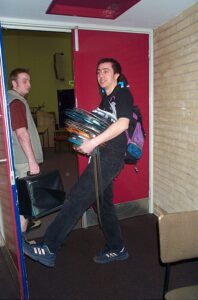
Lesson: Lift from the knees. Also, carry the kettle upstairs cold and boil it when you get there, you fool.
6. The cupboard of despair
Danger of death: 10%
After all this time, I genuinely cannot remember whether I witnessed this, or heard about it second-hand. But I am certain I know who was involved.
The weekend’s projectionist (or the society librarian) had two essential tasks to complete before the university closed on a Friday evening. One was to collect the actual film from USSU reception and stow it in G-box. The other was to collect the G-box keys from AVS. These keys were on two key-rings: one for the projection booth, and the other for the cupboard where all our essential equipment – including loudspeakers – were stored. If the projectionist forgot the keys, then there could be no film showing.
So, on one occasion, the team turned up to discover that we had remembered the projection booth keys, but not the cupboard keys. No cupboard, no speakers. On other occasions, we had solved this conundrum by hooking the projector into the theatre’s inferior built-in sound system. On this legendary day, however, our resourceful projectionist decided to crawl through the roofspace and climb into the cupboard through the suspended ceiling.
I’ve given this a danger rating of 10% because I think there was a realistic chance that he could have been trapped in the cupboard for the rest of the weekend or longer, like a form of medieval punishment. Had this stunt gone badly wrong, OFU could have had a literal skeleton in the closet.
Lesson: Only try this if you are the sole member of the society who is both thin enough to fit through narrow crawlspaces and tall enough to reach unaided into a ceiling void.
5. The cursed box office takings
Danger of death: 12%
Of all the Students’ Union societies, we probably handled the most cash. Particularly at the start of each semester, where we were selling both memberships and season tickets, we could be in possession of considerable amounts of hard currency. Naturally concerned for its security, we stored these piles of notes in … a small plastic box.
As Treasurer, it was my job to deliver the cash safely to the Union cashier. The sole security principle employed was: if I don’t draw attention to myself, then I probably won’t get mugged.
The procedure in full:
- Unlock G-box (definitely not drawing attention to myself, despite there being a lecture in progress and literally everybody turning around to see what’s going on).
- Collect the cash (definitely not drawing attention to myself, despite the rather obvious noise of coins being emptied).
- Stuff cash into jeans (definitely not drawing attention to myself, despite the now bulging wads of notes in both front and back pockets).
- Get to the Union as quickly as possible (definitely not drawing attention to myself, despite waddling uncomfortably the whole way).
Lesson: Get a money belt. Or a bodyguard. Or a card machine?
4. The treacherous trip home
Danger of death: 20%
We showed films in the evenings, in autumn, winter and early spring. This meant that it was often dark outside before the film started, and almost always when the film finished. After the film, the projectionist would have to despool the film and return it to the Union. And then it was time to go home.
These days, I don’t start watching a film after about 8pm, on the grounds that it will impinge on bedtime. But in those days, I could get away with not only watching the film, but then chatting with the audience / stewards afterwards, then taking the film apart, and then finally walking home to Bellfields, a brisk 45 minutes away – and all before a 9am lecture the next day.
I walked to and from campus – and into town – very frequently. I’m not certain that I ever considered myself to be at personal risk. Well, apart from that one time where I was assaulted by a drunken yob on Stoughton Road. The bigger picture, though, is that we had projectionists and stewards of all ages, genders, sizes and self-defence abilities. Some lived on campus and could be safely in bed five minutes after the film ended. The others?
Lesson: Learn and apply the meaning of “duty of care”.
3. The theatre of pitch-dark doom
Danger of death: 25%
I think there was probably a period in my third year at Surrey that I was spending more time in LT-G than in my own bed.
This is what LT-G looked like with the lights switched on:

On the other hand, this is what LT-G looked like when the projectionist first arrived to set up:

The entrance to the theatre was at the rear. The light switches were at the front. In the picture above – and my mind’s eye – I count about ten rows, or twenty stairs, between the two.
We were familiar enough with the place that we could move around it in total darkness. Not that we strictly had to (there were duplicate light switches inside the projection booth), but because we could, and because it often felt more … efficient? show-offy?
Lesson: If you fall and break both legs, don’t come running to me.
2. The possessed projector
Danger of death: 30%
I don’t have a picture of our actual projector in situ, which makes me a bit sad. It makes a cameo appearance in a terrible short film that we made called Messing About in G-Box, back in the period where we were attempting to preserve some of our old films. That day might plausibly have been the last time that it was ever switched on. I miss it.
<wipes tears from eyes> Anyway, it was a Fumeo 9000-series semi-pro 16mm projector with a big personality and an even bigger mystique. It had a tower to take large spools of film, and it had a slot to take an anamorphic lens, for the rare films that came in that format. There was a large lamp housing on the rear. The lamp had to be switched on separately from the projector motor, and the lamp would light – or “strike” – with a loud buzz. For projectionists unfortunate enough to forget, the lamp striking could also cause a very intense amount of audio interference on our sound system – loud enough to make an entire audience leap out of their seats.
Established legend had it that this lamp had to be cared for, lest it explode and kill somebody. There was a timer on the lamp housing; at every showing, we dutifully logged the hours as we nervously anticipated its certain supernova demise.
The appointed hour came and went. The lamp did not explode.
Lesson: Don’t believe everything you hear. But also, don’t mess around with arc lamps.
1. The demonic rewind table
Danger of death: 98%
Such a simple machine, the rewind table. Mount a full reel of film on the left-hand side, and an empty spool on the right; pass the film under a small spindle in the middle; and then switch on. The right-hand, motorised spindle transferred the celluloid from left to right spool. That’s it. We used it routinely: to prepare the film for showing; to rewind the film afterwards; and to break the film back down into its constituent parts.
Most of the time, the projectionist operated it on their own, before the stewards arrived or after they had left for the night. Which, in retrospect, is totally crazy, because the rewind table was alive, sentient, and just biding its time before it would rip somebody’s arm off.
If you can’t recall the rewind table – clearly you never used it – imagine a giant audio cassette, made out of steel, being fast-forwarded. Now imagine that someone’s removed all of the bits of the cassette that would protect you from sticking parts of your body into the moving mechanism. Now also imagine that you’re not concentrating properly, because it’s approaching midnight and you have an exam in the morning. It is genuinely a wonder that we didn’t see weekly dismemberments.
And it would have been all over in a flash. That thing was fast, like two connected washing machines on their top spin cycles. I reckon it took under 90 seconds to transfer a two-hour film from one spool to another. According to this guide, a two-hour film would be a little over 4,000ft in length. So the film is moving at … 30mph? Wait, that doesn’t sound that bad. Unless you accidentally grab the moving celluloid or shove your arm into the driving spool at top speed.
There were three key issues with the design of the rewind table that made it unnecessarily dangerous.
- The controls were located behind the moving film. So if something went wrong, the only way to stop the thing was to reach past the dual spinning wheels of death.
- There was a handy cut-out feature that quite often went wrong. The idea was that if the film broke, then the small central spindle would drop down and trip a switch. The problem was, it could also drop for other reasons, like the projectionist slowing the machine down slightly such that the film went a little bit slack. Get it wrong, and the motor would stop suddenly. (Get it really wrong, and the motor would jolt back into life and snap the film.) But the motor stopping wouldn’t necessarily be a problem, were it not for …
- There was no brake on the free-running left-hand spool. If the film snapped, or the motor cut out, then that spool would keep on spinning. And if it were holding 4,000 feet of film, then it would keep on spinning with impressive momentum. Loose celluloid would fly, at considerable speed, across the projection booth.
The mitigation against the last risk was to have a scarf handy. Not to wear – imagine that getting caught in the mechanism! – but held in the left hand, ready to act as an ad hoc brake if the spool needed to be decelerated in a hurry.
Every projectionist has at least one tale of woe relating to the rewind table. Often it was as simple as not being able to find the splices in a film that needed to be broken down and returned. For this, there were two possible solutions, depending on the projectionist’s level of conscientiousness and / or the time of night:
- Wind the film slowly from one spool to another, while gently feeling for the join.
- Just spool roughly 40 minutes’ worth and chop the film wherever.
But a decent number of projectionists will be able to tell horror stories of celluloid flying across the room, ending up in a big tangled mess across the projection booth floor. My own experience was with a costume drama (Mrs Brown, I think); it was a brand new print, that had never been spliced before. The stewards and I had to carefully untie the film – in the theatre auditorium, as there just wasn’t space in G-box – and wind it by hand back onto the spool, smoothing out the worst creases. The start of the showing was somewhat delayed. When we finally ran the performance, the print was filthy with carpet fluff and fingerprints, not to mention scratched to oblivion, across perhaps a minute or two of screen time. As projectionist, I couldn’t help but notice. “Ah, so that’s the bit that I single-handedly destroyed on its first ever showing. I wonder if we should tell Filmbank?”
Lesson: Are you kidding? Don’t let teenagers play with badly-designed fast-moving machinery, late at night, unsupervised!
What we did right
Most of OFU’s operating procedures were handed down in the form of coaching by experienced projectionists, before I finally codified the key processes into the OFU handbook. Like our legal and licensing obligations, safety was largely a matter of hearsay and established ritual.
Our H&S compliance basically came down to two rules that we followed without fail:
- Make sure that the fire exit lights are switched on.
- Count and log everyone in the theatre – paying guests and stewards.
Of course, we never actually had a fire alarm, so never properly tested these procedures, flimsy as they were. Fortunately, in 1997, no-one died. In 1998, no-one died. In 1999 …