
This is hardly a definitive record of everything going on in the world of film-making and film exhibition – more of a scrapbook of interesting things.
I’ve previously reported fairly heavily on the struggles that Cineworld faced during and after the pandemic. So I should draw that particular saga to its inevitable conclusion: the company collapsed, entering bankruptcy in the US in 2022 and entering administration in the UK in 2023. Retail investors, like myself, were wiped out. The company’s ill fortune was not entirely down to the long period of closure during Covid; the expansion that had taken Cineworld to being one of the largest cinema chains in the world had also loaded it up with huge debts. At the same time, the company suffered legal troubles from its botched attempt to buy the Canadian chain Cineplex, resulting in a huge fine.
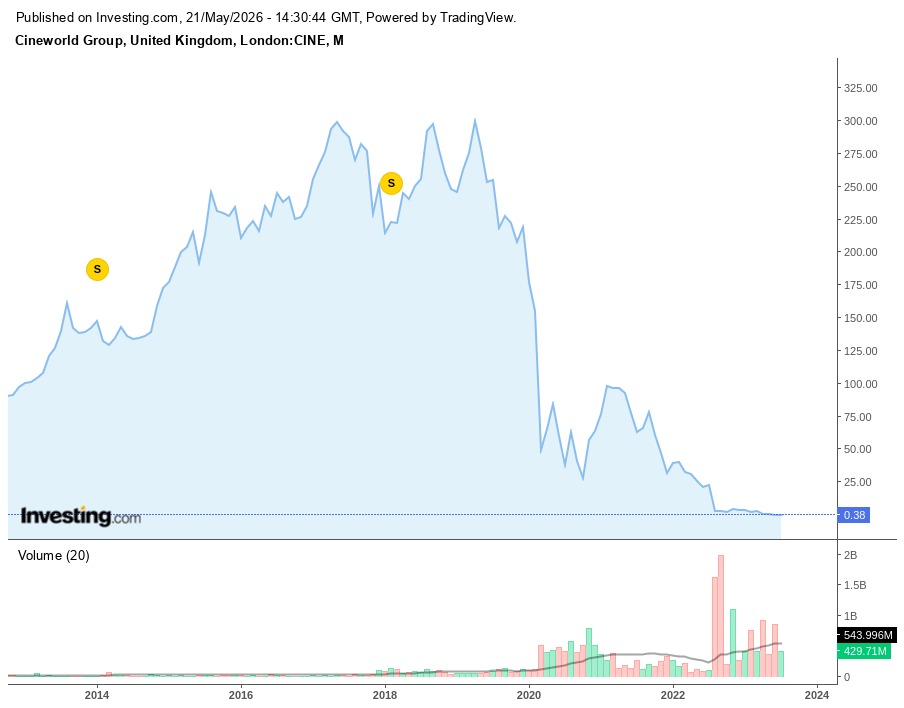
Despite all this, Cineworld has continued to trade, albeit with a reduced estate and with some of its planned expansions cancelled. And I learned a vital lesson about maintaining a diversified investment portfolio.
As is apparent from the share price, there was a moment towards the end of 2021 when Cineworld looked like it was in the clear; there were some huge hits in the pipeline and audiences looked set to recover. But even in the US, box office revenues have remained well below their pre-pandemic peak:

Letterboxd published a long analysis of the state of film exhibition in the US, particularly in smaller towns.
“Movie theaters are basically a dying art because of streaming. Streaming is killing the movie industry, and not just us. All movie theaters are struggling.”
Ann Sanders, manager of Liberty Theater, Colorado
I’ve seen a counter-argument that cinemas don’t sell films; they sell third spaces. People don’t need to go to a cinema to watch a film, just as they don’t need to go to a pub to drink a pint of beer. So, the argument goes, cinemas need to organise themselves around that truth.
But even where the exclusivity of the experience is not in doubt, there have been struggles. The downturn in cinema-going didn’t just affect the big players. In 2022, the Edinburgh International Film Festival suddenly collapsed after its organising charity entered administration. It was eventually rebuilt from scratch in time for 2024, while the Filmhouse cinema – which had been owned by the same charity – was refurbished and reopened in 2025 as a community project.
Still, a good cinema is still the best place to see a film, and a great cinema is an adventure in its own right. Time Out recently published its list of the greatest cinemas in the world – not just the biggest, most advanced or most beautiful, but those that inspire real depth of feeling in their audiences. There are plenty of UK gems on the list. The photo of the Odeon Leicester Square captures its incredibly rare surviving organ console.
Even in a homogenised, dumbed-down marketplace, cinema gems abound. So here’s a shout out to my local indie, the Sherborne, which – despite its 1990s website and despite being little more than a nineteenth-century church hall – is warm, friendly and excellent value for money.

Plus it has been fitted out with real care and attention to detail. It’s almost exactly the kind of thing that Andy and I would have aimed for, if we’d ever made good on our threat to open an independent of our own.

This also reminds me that it’s been almost a full decade since I reluctantly shut down my Old Cinemas website. The site was intended to showcase surviving examples of golden-age cinema architecture, at a time when many were falling into disuse or were being demolished. While even now I still collect the occasional pictures on my travels, by 2016 it had already been getting harder to maintain the website and it ultimately succumbed to a severe security issue in the underlying content management system. Besides, Cinema Treasures is already doing what I intended from the cataloguing side, and the Cinema Theatre Association from the historical research side, both far better and at greater scale than I could ever manage.
Moving on to production and distribution: the decline in traditional cinemagoing and the steady rise of streaming services – increasingly, siloed from one another – has also resulted in a period of consolidation amongst the major studios. Apart from the overt political interference, this has the potential to further hurt consumer choice and the film marketplace. For the record: MGM is currently owned by Amazon; Netflix was in the running to buy Warner Bros. (which owns HBO and Discovery, amongst others) but it now looks like Paramount will buy WB instead; Comcast (NBCUniversal) now owns Sky; and Disney now owns, amongst many others, 20th Century, Searchlight, Marvel and Lucasfilm.
Sometimes it seems like technology – especially film technology – is going backwards. It’s not just directors seeking a more authentic, analogue way of making films; it’s that entire new ways of storytelling can rise, expand and then disappear almost without trace. 3D films are a case in point; The Atlantic argues that “The future of film is behind us.” I still have a 3D TV and a number of Blu-Ray films but, once that TV fails, I will not be able to replace it. And, in truth, I really cannot remember the last time I watched a 3D film at home.
And finally, in non-film university news (or maybe not news, but mere speculation), the student accommodation known as Guildford Court is apparently scheduled for demolition. Actually, it’s been half a decade since the university announced plans to knock it all down in order to build a performing arts centre – intended to include a cinema. Presumably the pandemic scuppered those plans too, since the accommodation blocks still stand and are still marked on the campus map – but are not available to book on the university’s student accommodation website.
Guildford Court has always been weirdly subject to rumours and the current speculation is that there are bats that need to be re-homed before demolition can proceed. Previously most speculation centred around the accommodation’s diminutive size. This, presumably, means that Guildford Court fails to meet the demands reasonable expectations of a 21st century student customer. Fortunately, I never had the pleasure of needing to make a choice between fitting either myself or my belongings into my bedroom, but I do know several ex-OFU members did used to reside there and remember it fondly.