
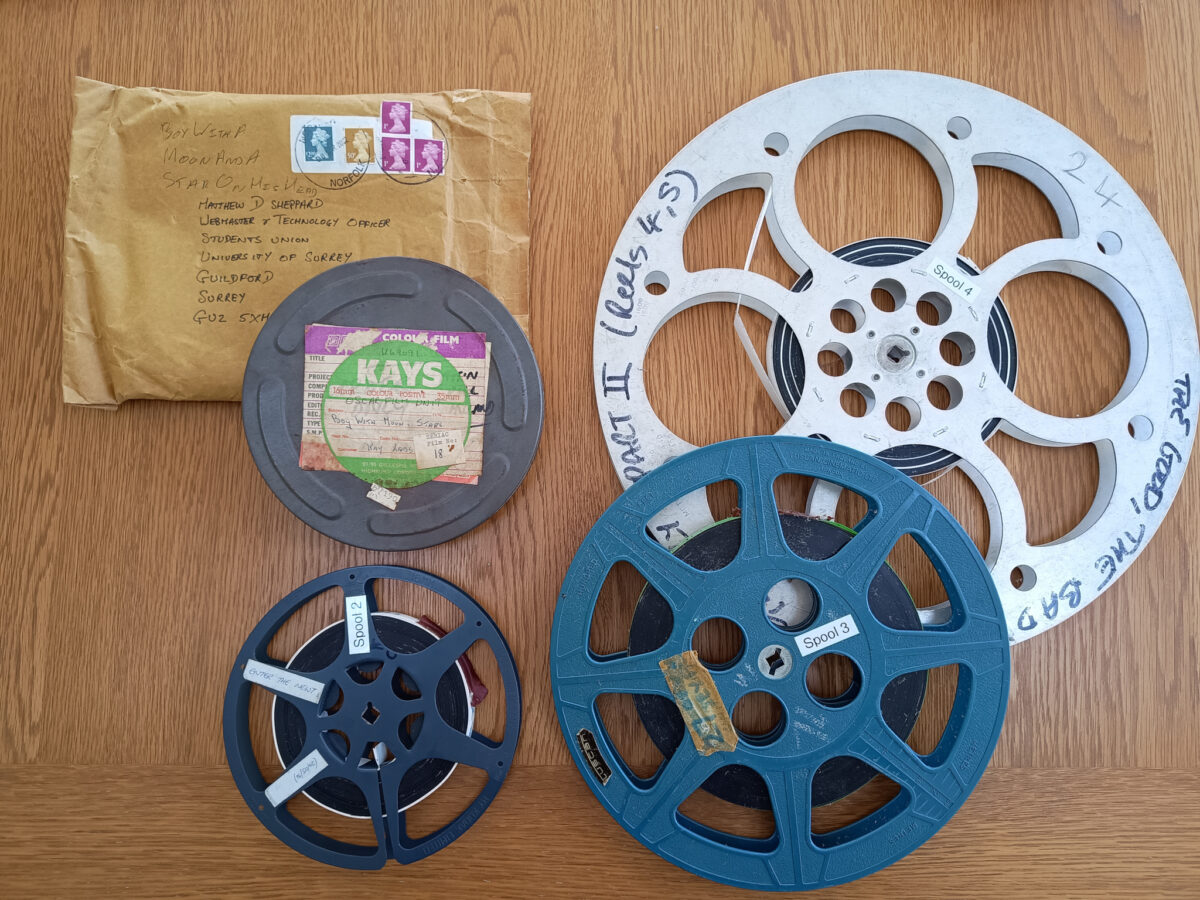
For the first time in a decade, Oscar Film Unit is proud to present three “new” films from our archive, each in a beautiful new high-definition transfer.
Four mysterious films
For the past twenty years or so, I’ve been storing four small spools of 16mm film in my loft. At some point, Scoot rescued these from G-box and posted me them to look after. They have been there ever since.
After all this time, I’m not even sure I remember what is on them. I’m pretty sure that one of them is the fabled Boy With A Moon And Star On His Head. However, I’m also pretty sure that the large silver reel is not The Good, The Bad And The Ugly, as labelled. It’s very short, and also it appears to be made up of several very brief clips. Similarly, the blue spool clearly doesn’t hold Toy Story. It is just possible that the smallest spool does actually hold Enter The Newt, a genuine old OFU film, but it might not.
Storing these films in my loft has meant that they are safe, but also that they are slowly decaying. Any photographic film will fade over time. Often, the dyes fade at different rates so that older films take on a pinkish hue. The large range of temperature changes in a loft will also contribute to warping of the film, or might cause splices to fail. The purpose of me storing these films in the first place was the vague hope that we might save them for posterity, eventually by converting them to a permanent high-definition digital archive.
Many years ago we digitised most of OFU’s archive. We dug through the cupboard in G-box and pulled out all the films we thought were worth saving. We did this using the only viable method open to us – the cheapest, most naive way possible. We got permission to return to LT-G for one last time and we projected each film in turn, recording them to digital video by pointing a camera at the screen. We did what we could, but every stage of the process would have tended to reduce the quality of the final output:
- We did nothing to prepare the films in advance, such as cleaning them or repairing broken sprockets.
- We used the best projector and screen that we had available, but could do nothing about brightness, mechanical jitter or marks on the screen.
- We recorded the films to digital video at the best quality then available in a consumer camcorder, standard definition. Barely a year later, Sony released a consumer HD camera that would have been a vast improvement.
- We then converted the DV files for long-term storage using the best available media codec of the time. Significantly better encodings have been developed since.
The resulting digital copies are low-resolution and dim, but they probably represent all that remains of OFU’s golden era of filmmaking … until now, at least.
Even if camera technology has vastly improved since, this method of saving our four mystery films is no longer open to us. We would need, at least, a working 16mm projector.
To view and preserve these films, we would need to have the transfer done professionally. And while there’s no particular reason why it should be done now, there’s also no point in waiting any longer: the films will only deteriorate further and I can’t imagine that 16mm transfer services will exist forever, or else will become prohibitively expensive as demand decreases. To put it another way, the best time to do this was fifteen years ago, but the second-best time is today.
Transfer and restoration
The film transfer comprised a high-resolution frame-by-frame scan of each film and an “AI” enhancement of the images.
In practice, I think at least some of the restoration used conventional, procedural techniques. Clearly, the colours are greatly improved and the jitter has been cleaned up – but these enhancements were both automated features of Adobe Premiere two decades ago, so no AI needed.
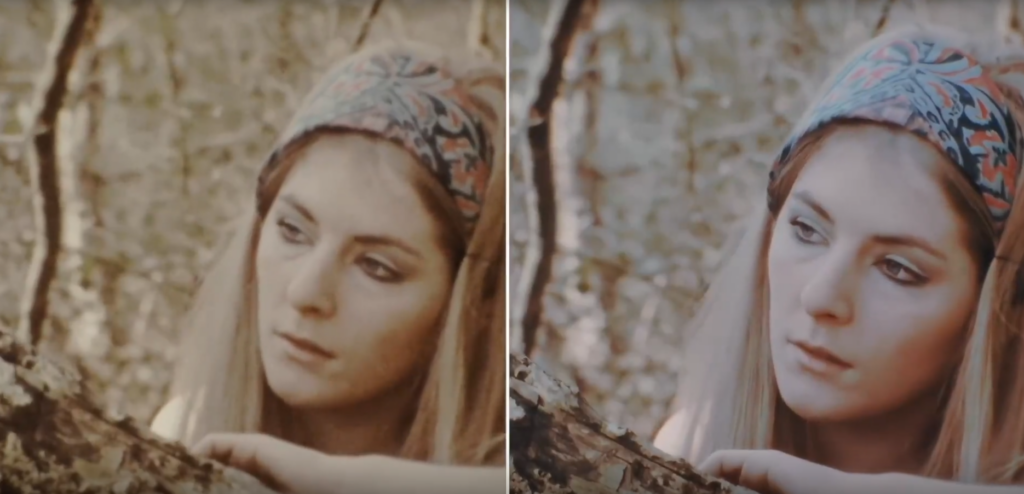
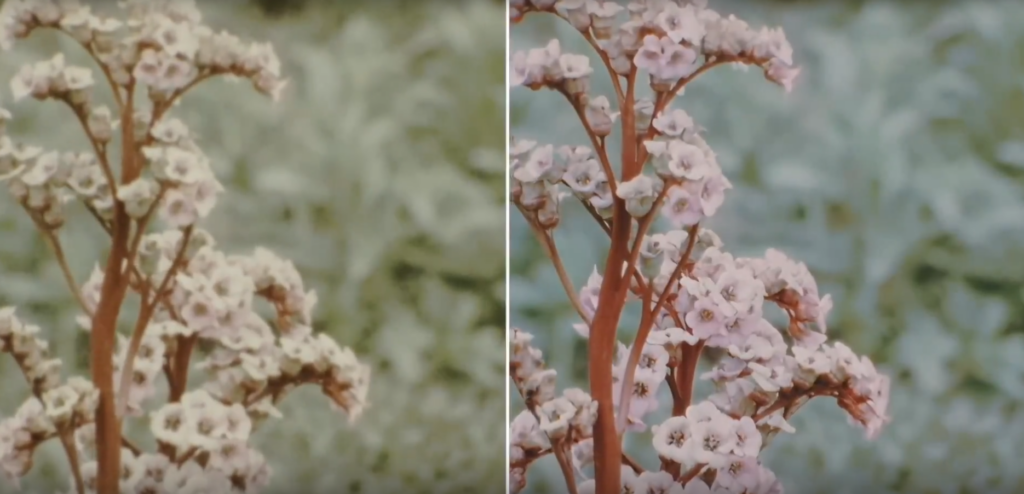
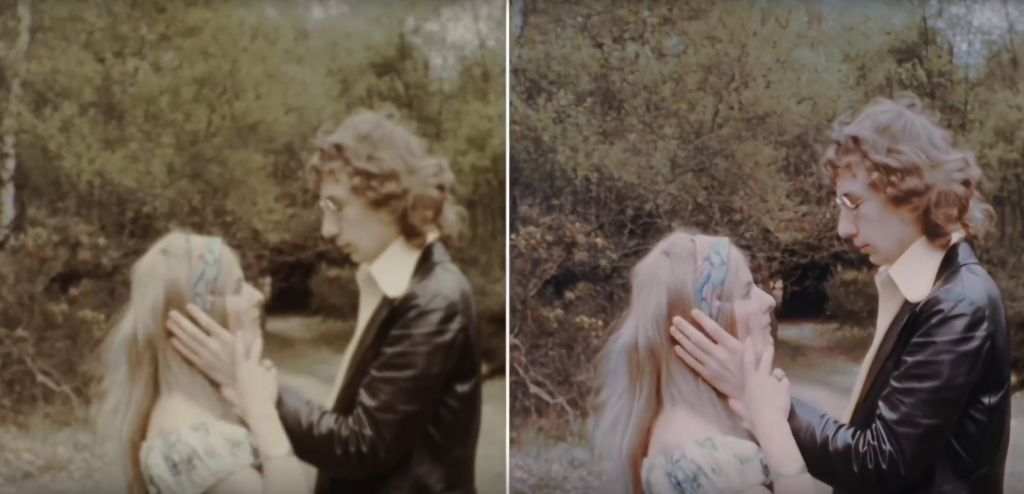
However, I can see the distinctive work of AI in some places. Some images have impressive sharpness and detail that is not present in the original film. It’s not always inferred perfectly, by any means. I believe the AI has wrongly reconstructed some elements, such as the engraved text on the drinker’s tankard.
And even the parts of the restoration that didn’t necessarily rely on AI have some minor problems. For example, the jitter: that is, the slight movements of the image between consecutive frames, caused by tiny imperfections in the original camera or filmstock. This is fixed very effectively by slightly zooming in to the frame, giving a small spill margin around all edges, and then matching the relative position of each consecutive frame to the last. Except this automated process doesn’t work at all when there is intentional movement within the frame, as can be seen during a pan (sideways movement) with overlaid text. The text should remain static in the frame, but instead it moves with the pan.
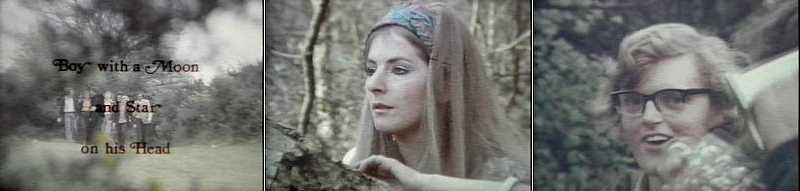
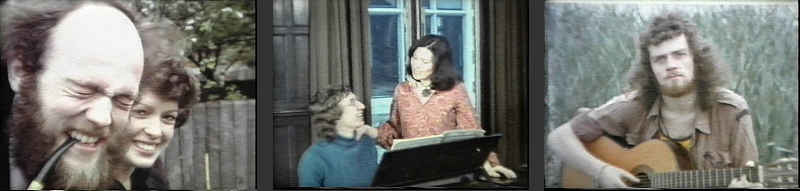
Despite these issues, overall, I’m quite satisfied with the restoration. I’m content that this is the best possible presentation of these films. I think this is true even if I cannot be certain of the original filmmakers’ intent. For example, these low-resolution stills from UoSSnaps may imply that the original film was intentionally shot to be low-saturation and hazy, in keeping with the dreamlike tone of the story. It’s possible that the transfer may have restored too much colour.
The soundtrack
Only one of the four mystery films has a soundtrack – in this case, a magnetic strip on the film. I feared that this was likely to have deteriorated even more than the images. Magnetic tapes are known to be fragile and susceptible to environmental changes. It’s even possible that the magnetic strip could have become detached from the film.
So I am pleasantly surprised by how well the original sound recording has survived. It is staggering to me that this soundtrack was recorded closer in time to the invention of synchronised-sound film – the days of The Jazz Singer in the late 1920s – than to the present day.
The mystery solved
OFU old-timers have probably recognised the stills above come from Boy With A Moon And Star On His Head. I’m particularly delighted to have seen this award-winning film at long last; it was legendary during my time in the society and yet the only major production that was missing from the archive when we did our original naive transfers. As a piece of art, it does not disappoint.
The second spool turned out to hold our copy of the film that I’m going to refer to as The Famous OFU COW-RAG Film. We didn’t used to call it that, but when I have previously used its “proper” name on this blog, I have invited a considerable amount of unwanted attention and spam from unsavoury parts of the Internet. This film was one of the collection that we previously transferred onto standard definition digital video. This new scan is, naturally, substantially better. Depending on your perspective, this is either a hilarious high-concept satire, a clever educational piece, or merely a fascinating time capsule.
The third spool holds OFU’s last major 16mm effort, Jaws In The Library, which I produced in early 2001. I don’t claim that it’s a great piece of art, and our ambition clearly exceeded our actual technical ability, but I have very happy memories of shooting it.
At this point, it’s clear that none of the four mystery reels are likely to include any of the truly historical material in OFU’s collection, in particular the RAG week documentaries or the footage of Stag Hill being constructed in the late 1960s.
Finally, that fourth spool with the short clips. I was rather hoping this might be something entirely new. Instead, I was surprised to discover that it’s the complete set of out-takes from Jaws In the Library. It comprises mostly establishing shots, title cards, and brief clips of Scoot holding a clapperboard. It’s quite interesting in its own way, but not a complete film.
In conclusion
I’ve found this whole project to be something of a rollercoaster of emotions. I’m disappointed to have lost the opportunity to do more with OFU’s archive, but I’m delighted to have been able to save Boy With A Moon And Star On His Head and, whether you’re seeing it for the first time or you were there during its production, I’m thrilled to be able to now share it with you.
One reply on “OFU presents …”
I’d love to see a still of this clapperboard Scoot.